
A woman empowered by technology: Ate Mau on family, farming, and future dreams

In Cagayan Valley, where agriculture is deeply woven into everyday life, women farmers like Maureen Ann Gervacio Blancad—fondly known as Ate Mau—are showing what it means to build resilience from the ground up. A farmer from Tuguegarao City, Cagayan, Ate Mau manages a three-hectare family farm where she grows corn, vegetables, and fruits while raising livestock alongside her husband and children.
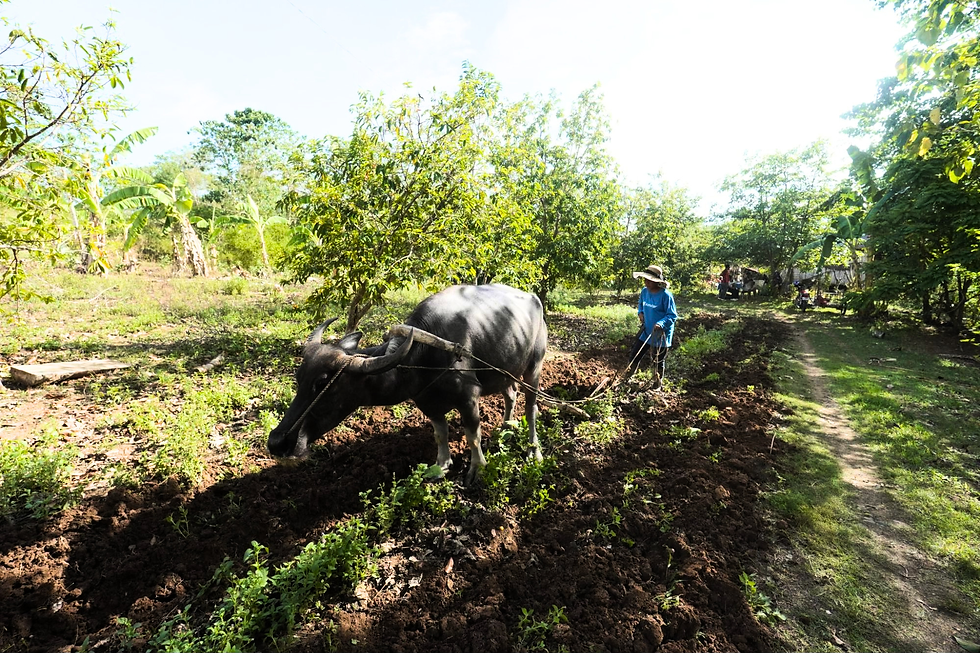
Ate Mau’s journey into farming was shaped by both circumstance and determination. After her husband suffered an accident that left him unable to tend to the farm, she stepped up to take on responsibilities that she had never imagined would become hers—including learning how to plow with a carabao. Since then, she has continued to adapt to the realities of farming, from prolonged drought and unpredictable weather, to the challenges of sustaining their livelihood.
One of Ate Mau’s first engagements was her participation in the GrowHer Training of Trainers (ToT) implemented by the Philippines Partnership for Sustainable Agriculture (PPSA) under the ASEAN Green Recovery through Equity and Empowerment (AGREE) Project. During the training, she deepened her understanding of sustainable farming and learned new ways to adapt to climate change. Ending in a culminating activity, Ate Mau then participated in the mentorship program under the Scaling Up Sustainability: Training 100 Filipino Farmers on Climate-Smart Practices and Entrepreneurship project , where she was mentored by Harbest Agribusiness and PLDT and Smart Communities, Inc. on both water management and digital marketing, respectively.
Recently, her story of empowerment was cascaded to fellow farmers and mothers through the PPSA’s Growing Together: Strengthening Food Security Through Mother-and-Child Farming Initiatives. Through these activities, Ate Mau shared her journey of becoming an empowered woman farmer, inspiring the audience through her public speaking and digital videos.
Her story is one of resilience, resourcefulness, and the growing role of women in agriculture—while inspiring her children and other young people to see farming as a future worth cultivating. In a feature in the local newspaper, Philippine Star, beyond the farm, Ate Mau shared how she has become a passionate advocate for agriculture through her digital platform, Buhay Bukid ni Maureen, where she shares her experiences, farming practices, and lessons from life in the countryside of Cagayan.
In this article, the PPSA asked Ate Mau some questions about herself, and she enthusiastically shared her thoughts with us.
What do you feel about sharing your knowledge with fellow farmers, especially farmers who are women and mothers?
“As a mother who took my husband’s role, I am now a woman farmer. The PPSA’s cascading activities were a great help because I saw how interested the farmers and mothers were during the training sessions. And it wasn’t just that—while I was explaining to them the importance of agriculture, you could really see that they wanted to apply what they were learning in their own lives, so that they could also teach their children and raise them with an appreciation for farming.
Because, of course, as mothers, we mothers serve as role models for the youth today. I really want to see more members of the new generation take our place.”

Do you think the next generation will engage in digital farming?
“I can already see that my children are genuinely interested in farming. Of course, that is something I instilled in them—that farming is very important. Not only that, digitally, they also have an FB page, and I even encourage them to upload content on there so that they can inspire and engage more young people like themselves to take a genuine interest in farming.
I can see that many young people are now becoming interested in farming, such as those who choose to pursue agriculture-related courses. That alone is already a huge help, and I hope these pupils can encourage even more young people and become role models for others.”

What happened after you took over your husband’s farming duties?
“I had to learn everything. I learned how to plow the fields and began handling all the farm operations myself while my husband took my role and helped take care of our children. Before that, I had no idea how to handle a plow, let alone control one with a carabao. We didn’t have any farm machinery, so I had to learn these things.”
How has climate change affected you as a farmer? For example, during times of drought or other extreme weather that could affect your income, are there other ways to support your livelihood?
“Over the years, I’ve seen how climate change has really taken a toll on farming. We deal with prolonged droughts during El Niño, both of which make farming even more uncertain than it already is. Sometimes, even fertilizers don’t work properly: when there’s no rain, that stunts the crops.
Recently, we have been in the season of drought and El Niño, and of course, the phenomenon had a huge impact on us farmers. We weren’t able to plant vegetables or corn. And even if some were able to plant, if there was no rain, the crops would get damaged because they couldn’t bear fruit. So it’s really difficult for us farmers.
When climate change impacts our crops—like during long droughts—I’ve had to look for other ways to earn a living. We started selling halo-halo at our home just so we’d have something to live on while waiting to plant corn or vegetables. It’s definitely not easy juggling farm work with other responsibilities. I also have to take care of our home, so every day is a balancing act between farming and household work.”
In what ways has the PPSA helped you address the impacts of climate change?

“I didn’t want to just sit back and watch our farm and income suffer. Through PPSA’s GrowHer Training of Trainers (ToT) program, I learned about sustainable practices that I immediately began applying. I started using drip irrigation and mulching to retain soil moisture and make the most out of our limited water. I also learned important techniques like crop rotation and organic soil management, all of which have helped improve our yield even in tough conditions.
One of the most important things I learned was how to navigate digital tools, thanks to PPSA’s partnership with PLDT and Smart Communities, Inc. It helped with other sources of livelihood such as selling halo-halo and running my own Facebook page [called Buhay Bukid ni Maureen], where I share my journey as a farmer-vlogger and connect with others in the community.”
In your opinion, what is the role of women in the agriculture sector and addressing climate change?

“Whenever I learn something from PPSA, I immediately share it with my husband and my digital followers. I always plan to share it with my husband—the one about our training with PPSA, the Training of Trainers. Also, a lot of my online followers are farmers from different places, and they’ve told me they’re grateful for what I share. They’ve learned from my experience with the PPSA’s GrowHer ToT program, and that really means a lot to me.
I truly believe women have a huge role to play in agriculture and climate action. We’re patient in the face of challenges. We don’t panic—we stay positive and always remind ourselves that every problem has a solution. I’ve proven that even as a woman, I can overcome the challenges of farming, especially now that the climate is so unpredictable. We just keep moving forward. Women are incredibly resourceful—we can handle this.”
For Ate Mau, this spirit of sharing is closely tied to her belief in the role of women in agriculture and climate action.
The PPSA as a stepping stone in Ate Mau’s long-term journey

Social media has opened new opportunities for Ate Mau’s livelihood, allowing her to market their produce directly and reach customers beyond their local community. Since starting her engagements with the PPSA, she has continuously built up her digital presence, and has continuously been featured in various publications. This is only the beginning for Ate Mau’s long journey ahead: a journey as an empowered woman in the field of agriculture.
“One day, I hope our farm becomes an integrated learning site. We're already on the path to getting accredited by the Department of Agriculture, and we’re working hard on improving our systems—especially in aquaculture management and using better machinery. I hope that we can include not just women but also the youth,” she mentions.
“There are many challenges for women farmers like me, such as climate change. I hope we continue to persevere. In our time, agriculture is not just for men but for women as well. I hope we can also cultivate love for farming in our children. Agriculture is extremely important in people's lives. That’s why I involve my kids in daily farming tasks—so they understand its value early on.
I’m truly grateful to PPSA. They have been a huge help to women farmers like me, especially now with the unpredictable climate. Thanks to what PPSA taught us, we’ve been able to improve our farming practices and face the future with more confidence.”
Looking ahead, Ate Mau hopes to develop their farm into a bigger learning space where she can share—especially to women and young people—to see agriculture as a field where they, too, can thrive.
- - -
This article highlights the personal journeys of a woman farmer trained through the GrowHer Training of Trainers under the ASEAN Green Recovery through Equity and Empowerment (AGREE) Project. Discover the inspiring stories behind their farms, their challenges, and their successes. Follow our series to gain insights and celebrate the remarkable contributions of women in agriculture, climate resilience, and innovation.
The farmer’s quotes in this article have been translated. While efforts were made to preserve their original meaning, some nuances may vary in translation.
AGREE is a research project funded by the International Development Research Centre (IDRC) and implemented by Grow Asia through its country chapters in the Philippines, Cambodia, and Vietnam. It aims to contribute a catalog of what's working, what’s needed, and how to scale women's economic empowerment via low-carbon strategies—a gap identified by Grow Asia on effectively mainstreaming gender across its network.
The Scaling Up Sustainability Project is funded by a GlobalGiving grant in partnership with Corteva and seeks to train 100 Filipino women farmers on climate-smart practices and agripreneurial practices. The project will unfold in two phases, starting with mentorship of women farmer champions who will receive guidance from experts to enhance their knowledge and skills. In the second phase, these mentored champions will take on the role of resource speakers to share their learnings with fellow farmers and strengthen knowledge transfer within their communities.


Comments