
From cacao to pangandoy: Susan Corbita and the reimagining of rural livelihoods
Updated: May 12


CACAO AS A DIVERSE, HIGH-VALUE CROP
Susan Corbita wakes before the heat settles over Paradise Embac in Paquibato District, Davao City. By the time sunlight filters through the cacao trees, she is already moving through the farm—gauging which branches will soon bear fruit.
When people think of cacao, they usually imagine chocolate—something sweet and familiar, perhaps a cup of chocolate (called sikwate), locally produced tablea. Less visible is cacao’s role beyond food, from cosmetics to wellness products, or its growing importance as a high-value crop in the Philippines. Long valued as a source of livelihood and opportunity for many farming communities, cacao has become a pathway for positive change in the Philippines. Through the support of Mennonite Economic Development Associates (MEDA) Philippines, funded by the Government of Canada, efforts to strengthen the cacao sector through partnerships with small and medium enterprises (SMEs) have reached farmers like Susan.
Farming is steady and repetitive, but for Susan, it is also grounding. Each cacao pod represents something she once did not have: a future she can plan for. Susan is a mother and a farmer.
For much of her life, stability felt distant. Today, cacao farming anchors her family’s livelihood and shapes what she calls their pangandoy—a Visayan word for dreams or aspirations. Through cacao, Susan has been able to pay off debts, open a bank account, and begin saving for the uncertainties she knows women often carry. For women like Susan, cacao is not an end product but a daily practice—one that intersects with care work, household decision-making, and long-term security. Cacao’s impact stretches far and wide, shaping women's lived experiences in profound ways.
Susan farms alongside her husband, but her role extends beyond child rearing or supplementing income. She sets targets for their cacao farm, tracks earnings, and plans how profits are used. For Susan, financial independence is not about personal luxury; it is about preparedness.
RURAL WOMEN'S ASPIRATIONS ARE DIFFERENT FROM MEN'S
This is significant in rural communities, where women often shoulder unpaid care work while facing fewer employment opportunities. According to the Asian Development Bank, the trade-off costs of caregiving are higher in rural areas, as institutional support and employment options for women remain weaker compared to urban settings.
The pangandoy or aspirations of women are different from the needs of men. When asked what her aspirations are, Susan answered with certainty. “Gusto ko makapag-ipon para sa future namin [I want to be able to save for our future],” she explained. As a woman, she is acutely aware that when children or grandchildren fall ill, it is often women who absorb the financial and emotional burden. Savings, for her, are a form of protection—not just for herself, but for her family.


This shift toward stability did not happen overnight. The Corbita family’s cacao farm was strengthened with support from Kennemer Eco Solutions Inc. (KenEco)---one of MEDA’s partner SMEs—a Philippine-based enterprise that promotes nature-based approaches to climate change mitigation while supporting sustainable rural livelihoods. Through technical guidance and livelihood support, the family was able to establish cacao as their primary source of income, rather than a supplementary one.
As their earnings became more predictable, changes followed at home. Susan strengthened her relationship with her husband as they continued working on their cacao farm. She wouldn’t remain on the sidelines of family decision making, but has also experienced setting targets for their cacao farm in order to generate profit.
For her husband though, pangandoy sounds a bit different: Susan’s husband met his goal of putting up a piggery and investing in other streams of income.
“Yung asawa ko, dati, umiinom ‘yan. Pero umiba ang mindset niya. Pinaghirapan mo yan, tapos ibibili mo lang ng inumin?”
[“My husband—before—used to drink. But his mindset changed. You worked hard for that, and then you’re just going to spend it on alcohol?”]
Susan shared that as her husband began to see tangible financial returns, his mindset gradually shifted and his vices diminished. Motivated by this change, the couple went on to encourage their neighbours to avoid squandering their hard-earned money on harmful habits.
MEDA’s project, Resilience and Inclusion through Investment for Sustainable Agrikultura (RIISA), applies a gender lens to invest in inclusive, environmentally sustainable cacao enterprises that strengthen smallholder participation and attract new capital to build sector resilience.
Given the lack of women leaders in agriculture, Susan herself, after receiving training from MEDA and KenEco on cacao farm management and regenerative practices, was empowered to convince her neighbours to farm cacao as a crop as well, establishing her as a woman with a voice in a sector otherwise known for having mostly male leaders in cooperatives and decision-making seats.
AN AWARENESS OF CLIMATE CHANGE
Susan was also motivated to participate in KenEco’s carbon credit program by her growing awareness of climate change. She observed that areas with more trees were noticeably cooler, reinforcing the importance of forest cover and biodiversity—principles echoed in KenEco’s seminars and community orientations, which she was able to attend. Through carbon credits, Susan receives monetary returns that she deliberately deposits into her savings, using the income not for short-term consumption but as a means of building stability, while contributing to long-term climate resilience.
MAKING WOMEN'S WORK VISIBLE AND CENTRAL
Yet Susan’s story is not only about livelihood. Earlier in her life, militarization in her community created constant fear and instability. The stress took a severe toll on her health, culminating in a miscarriage. Long after, the sound of gunfire would make her physically ill, triggering fear and distress that lingered in her body.

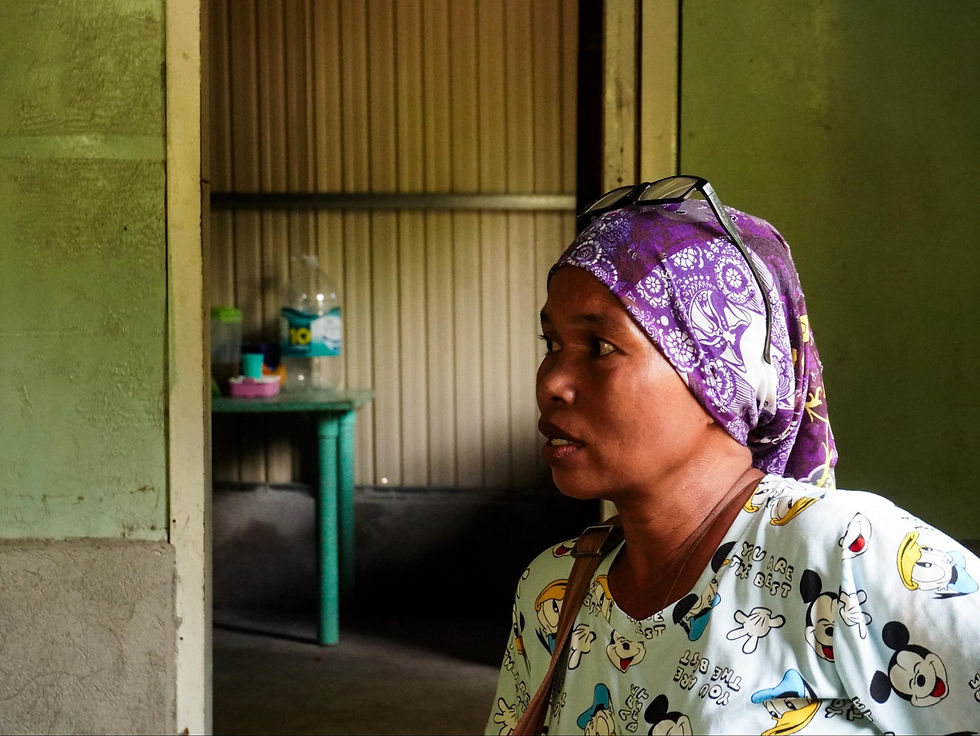
These experiences shaped her determination to seek a different path. With support and partnerships from institutions and a more secure livelihood, Susan and her husband were able to rebuild in an environment that felt safer and more predictable. Today, she describes her life as calmer—still demanding, but no longer governed by fear. Cacao has not erased hardship from Susan’s life. What it has given her is room to breathe, plan, and hope. In the steady rhythm of farm work and the careful habit of saving, pangandoy becomes tangible—not as a distant dream, but as something cultivated, one harvest at a time.
—
Susan Corbita’s experience reflects the findings of the G-ESG business case, which shows how inclusive, environmentally sustainable, and well-governed cacao enterprises translate into real livelihood gains for smallholder farmers—particularly women. Through partnerships with SMEs like Kennemer Eco Solutions and Agronomika Finance Corporation under MEDA’s RIISA project, cacao becomes not only a high-value crop, but a foundation for financial security, women’s decision-making, climate resilience, and long-term household stability.
Learn more about the Business Case Study: https://tinyurl.com/GESGBusinessCase
About the Business Case Study: This business case examines how integrating Gendered–Environmental, Social, and Governance (G-ESG) practices across the cacao value chain contributes to improved productivity, income growth, risk management, and market access among small and medium enterprises and smallholder farmers in the Philippines. It demonstrates that sustainability and inclusion can deliver measurable business value while strengthening long-term resilience and competitiveness.
—
About RIISA: The RIISA project, implemented by MEDA and funded by Global Affairs Canada, targets 5,400 smallholder farmers—40% of whom are women—and indirectly benefits 25,000 farmers through partnerships with cooperatives, associations, and SMEs. Through gender-responsive training and capacity strengthening initiatives, the project promotes environmentally sustainable livelihoods and profitable agribusiness opportunities and supports farmers to adopt sustainable and inclusive practices. MEDA also partnered with PPSA in developing the project’s Strategic Learning Agenda (SLA) and co-creating knowledge products on G-ESG practices.
Learn more about the Strategic Learning Agenda: https://www.ppsa-ph.org/riisa-sla


Comments